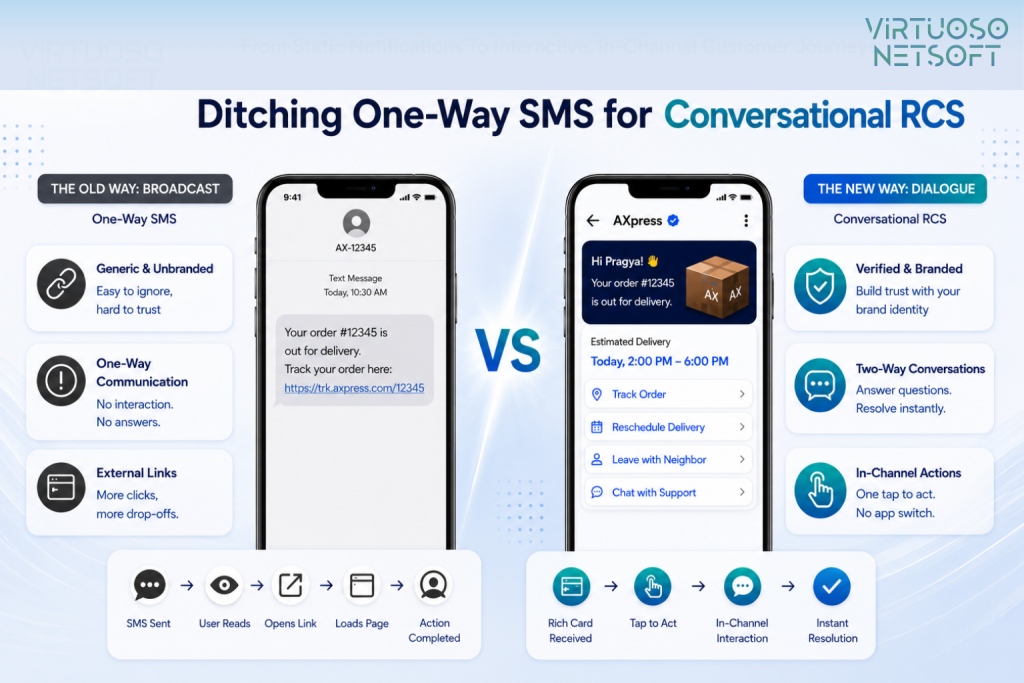
The Customer Experience Problem: Message Friction
For nearly three decades, corporate communication has relied on a simple, broadcast-heavy formula: send a plain-text message, attach a tracked URL, and hope the customer clicks.
That model worked when the inbox was quiet. Today, consumers expect the same interactive experience from brands that they already enjoy across modern mobile applications. They tap, swipe, choose, customize, and converse.
Consider a familiar delivery notification:
“Your package is out for delivery. Click here to track: [tracking link]”
The message is functional, but the journey is fragmented. To change a delivery window or ask a simple question, the customer must leave the inbox, open a browser, wait for a page to load, and navigate another interface.
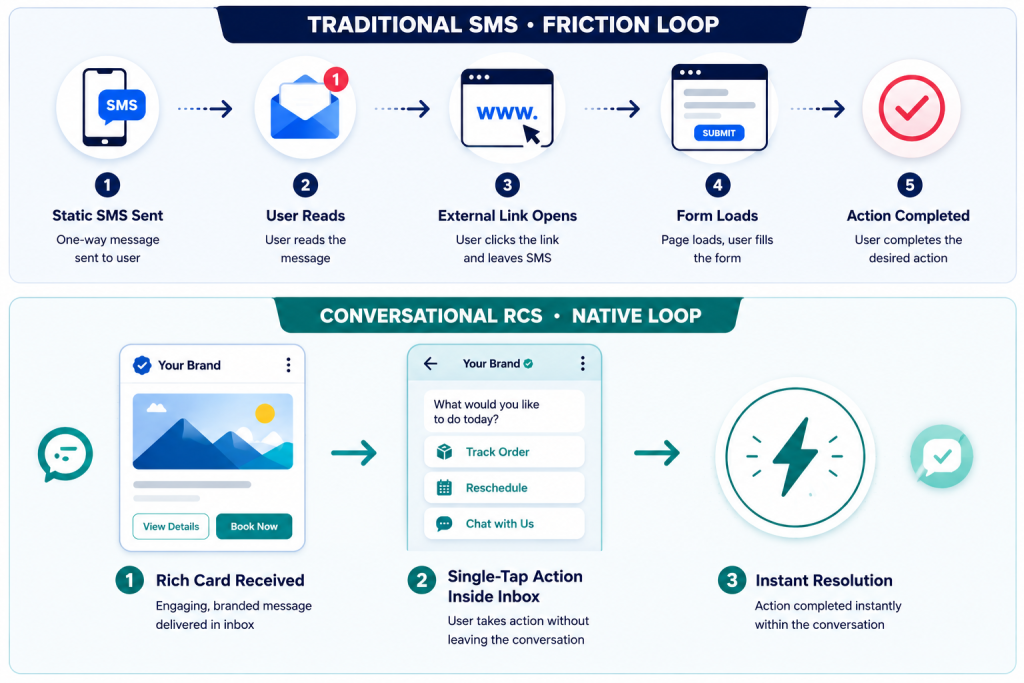
Every additional step creates another opportunity for abandonment. This is the central weakness of one-way messaging: the message delivers information, but the customer still has to do the work.
From Friction Loop to Native Resolution
Traditional SMS also creates three structural limitations:
- Limited brand assurance: plain-text messages can arrive from shortcodes or numbers that are difficult for customers to distinguish from phishing attempts.
- Limited interactive depth: traditional SMS cannot natively deliver the rich media, carousels, and interactive action patterns available in richer messaging environments.
- One-way dead ends: when a customer replies with a question such as “Can I reschedule?”, a broadcast workflow may be unable to turn that response into a meaningful service interaction.
The Strategic Shift: From Broadcasts to Customer Journeys
Moving to conversational RCS is not simply an exercise in making messages look better. It represents a
change in how an enterprise designs customer touchpoints: the message becomes an entry point to an action, workflow, or conversation.
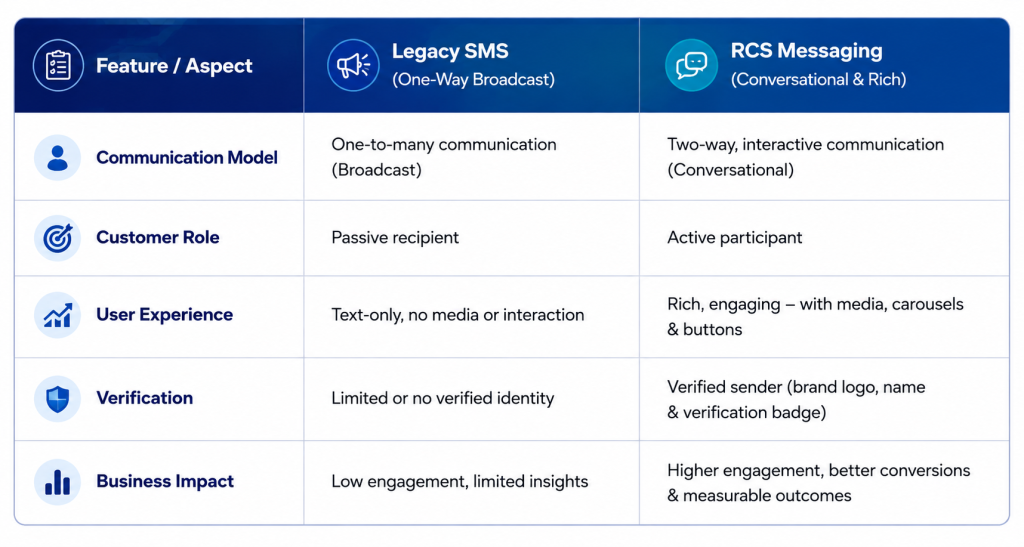
Anatomy of a Conversational RCS Journey
The value becomes clearer when a routine transactional alert is re-engineered as a two-way dialogue.
Scenario: E-Commerce Delivery Exception
Legacy SMS: “Delivery attempt failed for Order #8821. Call 1800-XXX-XXXX or click here to reschedule.”
Typical outcome: customer frustration, avoidable call-center demand, and a higher risk of order abandonment.
Conversational RCS: a branded, verified message featuring the company logo, item imagery, and a real-time status card.
Suggested actions: [Re-attempt Today] [Change Address] [Leave with Neighbor] [Chat with Support]
With a single tap on “Leave with Neighbor,” the customer can provide instructions within the messaging experience, while the underlying workflow updates the delivery process. The key advantage is not the button itself; it is the removal of unnecessary context switching between the notification and the resolution.
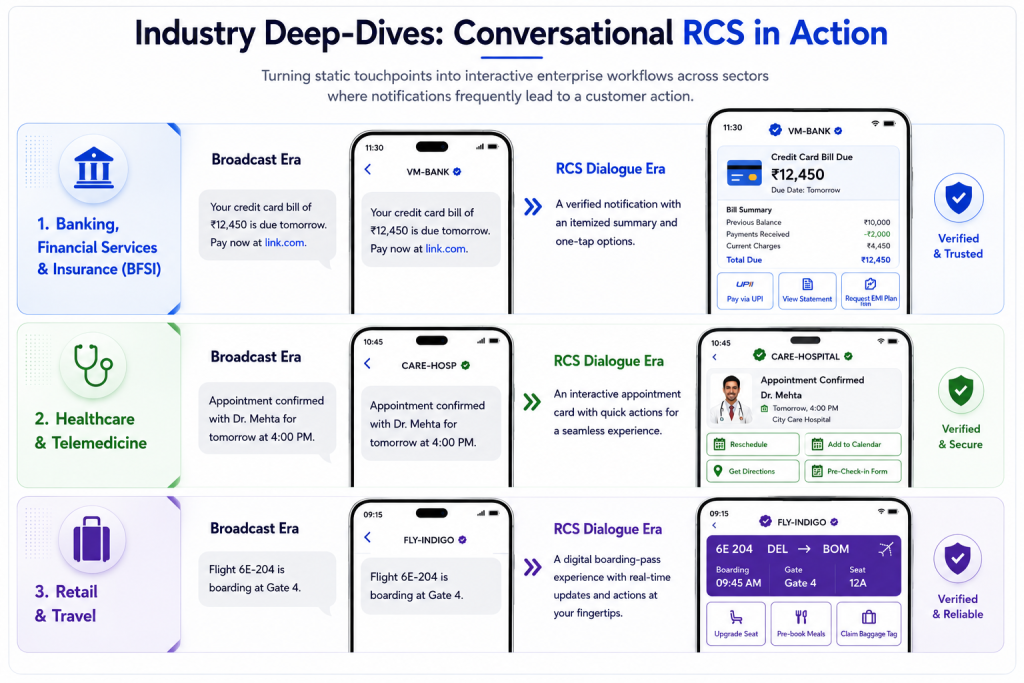
Industry Deep-Dives: Conversational RCS in Action
RCS can turn static touchpoints into interactive enterprise workflows across sectors where notifications frequently lead to a customer action.
Why RCS Requires a Strategic Orchestration Partner
Recognizing the value of conversational messaging is only the first step. Deploying it securely, reliably, and at enterprise scale requires the messaging layer to work with the rest of the customer and operational stack.
RCS is an open, global telecom standard, but enterprise deployment involves more than API access. It can require fallback mechanics, carrier connectivity, channel orchestration, analytics, security controls, and integration with existing business systems.
This is where a partner such as Virtuoso Netsoft (VNS) can position the messaging layer as a broader customer-engagement capability:
- Seamless fallback architecture: route eligible users through RCS while using alternate channels such as WhatsApp or SMS with smart short links when RCS is unavailable.
- Omnichannel orchestration: bring RCS together with existing WhatsApp Business, SMS, and CPaaS capabilities through a centralized conversation layer.
- Enterprise security and compliance: integrate with CRM, CDP, and backend analytics while supporting the organization’s data-governance, security, and regulatory requirements.
The Future Belongs to Brands That Listen, Not Just Loudspeakers
Sending one-way text messages to a database is no longer enough for enterprises competing on customer experience. Customers increasingly expect brands to help them resolve problems quickly, inside the channels they already use.
By moving beyond the static SMS megaphone and designing conversational RCS journeys, enterprises can turn routine notifications into interactive service and transaction opportunities—while creating the potential to reduce avoidable call-center demand and improve conversion.